Sociology 101
Introduction to Sociology
3 units; 3 hours lecture
Prerequisite: eligibility for English 1A Credit, degree applicable Transfer CSU, UC
In this course students analyze the influence of the social environment on behavior and social life using sociological theoretical perspectives. Components of social structure and social culture are critically examined through sociological theories and concepts including socialization, deviance, social institutions, and social change. Inequalities based on issues such as social class, race, ethnicity, gender, and age will also be analyzed.
Prerequisite: eligibility for English 1A Credit, degree applicable Transfer CSU, UC
In this course students analyze the influence of the social environment on behavior and social life using sociological theoretical perspectives. Components of social structure and social culture are critically examined through sociological theories and concepts including socialization, deviance, social institutions, and social change. Inequalities based on issues such as social class, race, ethnicity, gender, and age will also be analyzed.
Course Objectives:
The objectives of this course are as follows:
Student Learning Outcomes
As a result of taking this course, students will be able to:
ADA Statement
El Camino College is committed to providing educational accommodations for students with disabilities upon the timely request by the student to the instructor. A student with a disability, who would like to request an academic accommodation, is responsible for identifying herself/himself to the instructor and to the Special Resources Center. To make arrangements for academic accommodations, contact the Special Resources Center.
Required Materials
Course Expectations
Exams
Grading
Dropping the class
Standards of Student Conduct
(excerpted from the El Camino College Catalog):
1. Dishonesty, including but not limited to cheating, plagiarism or knowingly furnishing false information to the College.
2. Forgery, alteration, or misuse of college documents, records, or identification.
3. Violation of college policies or off-campus regulations, including but not limited to campus regulations concerning student
organizations, the use of college facilities, or time, place, and manner of public expression.
4. Possession or use of alcoholic beverages on college property or at any college-sponsored event except where allowed as noted in Section 25608 of the Business and Professions Code.
5. Possession or use of any weapon, firearms or explosives.
6. The use, sale, or possession on campus of, or presence on campus under the influence of any controlled substance or any poison classified as such by Schedule D in Section 4160 of the Business and Professions Code.
7. Continued disruptive behavior, continued willful disobedience, profanity or vulgarity, or continued defiance of the authority of, or abuse of, college personnel or to anyone on campus.
8. Willful misconduct which results in injury or death to a student or college personnel.
9. Assault, battery, sex crimes including sexual assault or rape, or any threat of force or violence upon a student or college personnel.
10. Sexual harassment which includes unwelcome sexual advances, requests for sexual favors, and other verbal or physical conduct of a sexual nature.
11. Participation in hazing or commitment of any act that tends to injure, degrade or disgrace a student or college personnel.
12. Obstruction or disruption of teaching, research, administration, disciplinary proceedings, or other authorized college activities including but not limited to its community service functions or to authorized activities held off campus. Obstruction or disruption includes but is not limited to the use of skateboards, bicycles, radios and roller skates.
13. Unauthorized entry to or use of college facilities, equipment or supplies.
14. Theft or deliberate damage to property of a college staff member, a student, or a visitor to the college including but not limited to the Library, Bookstore, and Food Service areas. 15. Defacing or damaging any college real or personal property.
16. Failure to comply with the directions of a member of the college certificated personnel, college management or supervisor personnel, or campus police acting within the scope of his or her duties.
17. Smoking in any area where prohibited by law or by regulation of the Governing Board.
18. The commission of any act constituting a crime under California law, on the campus or at a college-sponsored event.
19. Persistent, serious misconduct not listed in Items 1-18 above.
The objectives of this course are as follows:
- Define and describe sociology as a field of study and distinguish it from other disciplines in the social sciences.
- Explain and apply the sociological imagination as defined by C. Wright Mills.
- Identify and describe key theoretical perspectives in sociology, including functionalism, conflict, and interactionism. Analyze the strengths and weaknesses of each perspective relative to a variety of social situational circumstances.
- Identify and analyze prominent classic theorists in sociology, such as Karl Marx, Max Weber, and Emile Durkheim, as well as contemporary theorists, such as Peter Berger, George Ritzer, and Talcott Parsons and their contributions to the field of sociology.
- Identify the six steps in the scientific method and distinguish between qualitative and quantitative research methods.
- Evaluate the advantages and disadvantages of research methodologies sociologists use to gather and analyze data.
- Articulate dimensions of material and nonmaterial culture, including norms, values, and symbols.
- Classify and define micro and macro elements of social structure, including status, role, social groups, organizations, and institutions.
- Identify agents of socialization and describe the process of socialization throughout the life course. Explain the “nature vs. nurture” debate and assess socialization theories of human development.
- Define deviance and social control. Identify and apply theories used to explain deviant behavior.
- Demonstrate an understanding of sociological concepts relating to social stratification and inequality.
- Describe major social institutions and evaluate their impact on individuals and groups in American society. Discuss historical and contemporary changes in these institutions.
Student Learning Outcomes
As a result of taking this course, students will be able to:
- Accurately define and describe the discipline of sociology using a scientific approach.
- Demonstrate a thorough understanding of social research methodologies including measurement instrument validity and reliability.
- Articulate analytical knowledge of the major agents of socialization, and their role in shaping individual identity and group behavior at both the micro and macro levels.
- Explain the impact of groups on individual conformity, obedience and decision-making.
- Identify the major sociology perspectives and their respective level of analysis.
- Competence in describing visual media using sociological terminology including print, video and music forms.
- Understanding of the role that culture plays in shaping morality, worldview and familial role.
ADA Statement
El Camino College is committed to providing educational accommodations for students with disabilities upon the timely request by the student to the instructor. A student with a disability, who would like to request an academic accommodation, is responsible for identifying herself/himself to the instructor and to the Special Resources Center. To make arrangements for academic accommodations, contact the Special Resources Center.
Required Materials
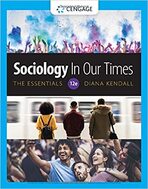
- Sociology In Our Times: The Essentials (7th or 8th Edition) by Diana Kendall (Thomson Learning) - it is recommended that you bring your textbook to class each session.
- 4 scantron forms (purchase in bookstore) - please bring these with you on test days as they will not be provided.
Course Expectations
- Participation - Students enrolled in the course are expected to complete all assigned weekly readings, actively engage in online discussions.
- Academic dishonesty – Cheating on exams and/or plagiarism will result in an "F" (failure) for the specific assignment. All written assignments must be your original work. When using other works for support or direct quotes, indicate the source using the appropriate formalized method (MLA style or APA).
Exams
- You will have four exams - only the top three will count towards your grade. Exams cannot be made up. In the event that you MISS an exam due to unforeseen circumstances, that grade, "zero", will not count against you as it will be the one that is not calculated, therefore, you need to take at least 3 of the exams scheduled.
Grading
- Top Three exam grades (worth 80 points each) = 240 pts.
- Four SOC-LENS presentations worth 25 pts. each = 100 pts.
- Final PREZI project = 60 pts.
- TOTAL POINTS FOR CLASS: 400 PTS.
- Letter grade calculation: Divide total points by 400 to get %
- A = 90 - 100 %
- B = 80 - 89 %
- C = 70 - 79 %
- D = 60 - 69 %
- F = 59 % or less
Dropping the class
- Students are responsible for formally dropping the class through the registration office. PLEASE CONSULT THE COURSE SCHEDULE for SPECIFIC DATES.
Standards of Student Conduct
(excerpted from the El Camino College Catalog):
1. Dishonesty, including but not limited to cheating, plagiarism or knowingly furnishing false information to the College.
2. Forgery, alteration, or misuse of college documents, records, or identification.
3. Violation of college policies or off-campus regulations, including but not limited to campus regulations concerning student
organizations, the use of college facilities, or time, place, and manner of public expression.
4. Possession or use of alcoholic beverages on college property or at any college-sponsored event except where allowed as noted in Section 25608 of the Business and Professions Code.
5. Possession or use of any weapon, firearms or explosives.
6. The use, sale, or possession on campus of, or presence on campus under the influence of any controlled substance or any poison classified as such by Schedule D in Section 4160 of the Business and Professions Code.
7. Continued disruptive behavior, continued willful disobedience, profanity or vulgarity, or continued defiance of the authority of, or abuse of, college personnel or to anyone on campus.
8. Willful misconduct which results in injury or death to a student or college personnel.
9. Assault, battery, sex crimes including sexual assault or rape, or any threat of force or violence upon a student or college personnel.
10. Sexual harassment which includes unwelcome sexual advances, requests for sexual favors, and other verbal or physical conduct of a sexual nature.
11. Participation in hazing or commitment of any act that tends to injure, degrade or disgrace a student or college personnel.
12. Obstruction or disruption of teaching, research, administration, disciplinary proceedings, or other authorized college activities including but not limited to its community service functions or to authorized activities held off campus. Obstruction or disruption includes but is not limited to the use of skateboards, bicycles, radios and roller skates.
13. Unauthorized entry to or use of college facilities, equipment or supplies.
14. Theft or deliberate damage to property of a college staff member, a student, or a visitor to the college including but not limited to the Library, Bookstore, and Food Service areas. 15. Defacing or damaging any college real or personal property.
16. Failure to comply with the directions of a member of the college certificated personnel, college management or supervisor personnel, or campus police acting within the scope of his or her duties.
17. Smoking in any area where prohibited by law or by regulation of the Governing Board.
18. The commission of any act constituting a crime under California law, on the campus or at a college-sponsored event.
19. Persistent, serious misconduct not listed in Items 1-18 above.